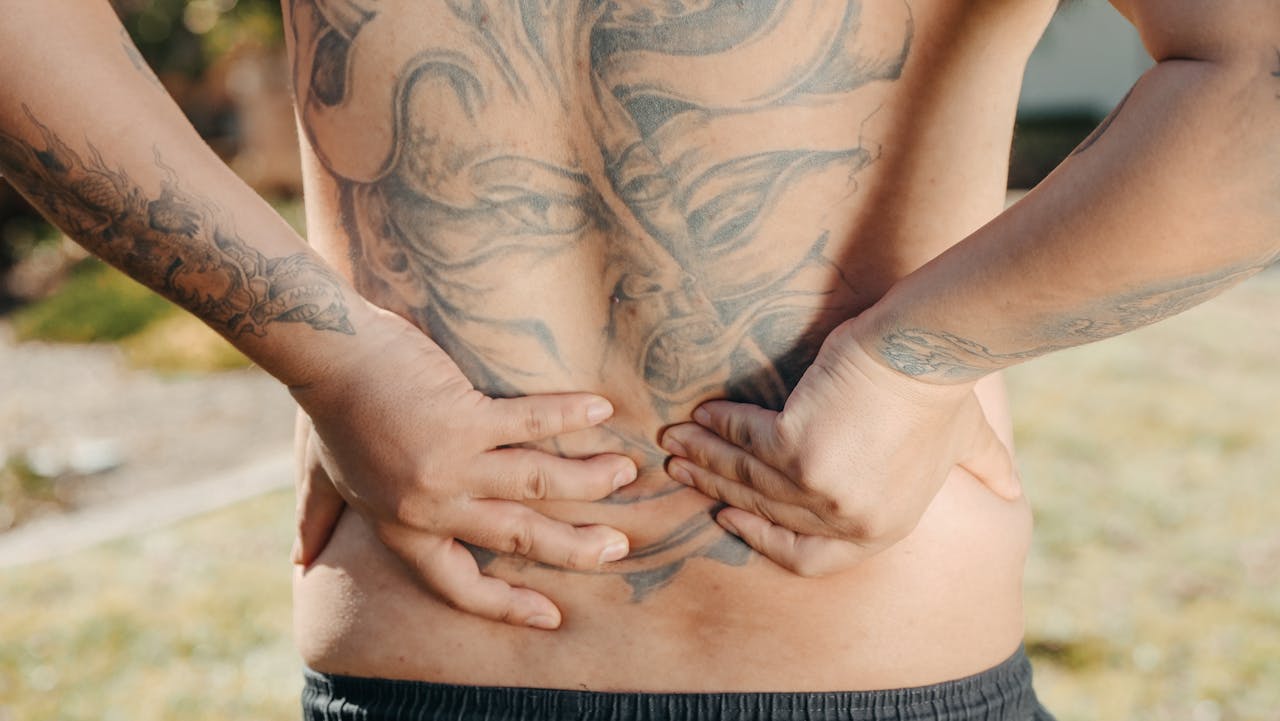
How to Fix Back Pain: Naturally
Back pain is something almost all adults are familiar with.
Some of us deal with it daily, and some of us have bouts of pain that come and go.
The truth is age, gravity, and activity will absolutely produce various pains, and as our back carries the weight of our body, it is likely to hurt sooner or later.
Back pain is one of the most common reasons people walk into doctors’ offices.
And it almost never starts the way people think it does.
How Does Debilitating Back Pain Begin?
Back pain isn’t always the result of a catastrophic injury.
Sure, some pretty bad cases start with that. But most back pain begins quietly.
A little stiffness in the morning. A twinge when bending over. A subtle hesitation before lifting something that used to feel easy.
The problem is that, over time, people begin to change how they moveto avoid that discomfort.
They stop twisting, start bracing before bending, avoiding certain movements altogether.
Sleep becomes lighter because they can’t find a comfortable position. Activity decreases. Muscles stiffen. Confidence fades.
The problem is that chronic low back pain is not just pain. It is a feedback loop.
As an integrative physician, I do not view back pain as a mechanical defect to be silenced. I look at it as a signal. The body is telling you something about load, movement patterns, stress, and adaptation.
The encouraging part is this: in most cases, the body can relearn how to move well again.
What Actually Causes Chronic Low Back Pain
Most chronic low back pain is labeled “non-specific.” That sounds frustrating, but it is actually reassuring. It means there is no fracture, no tumor, no catastrophic structural failure.
This means it usually reflects disrupted motor control, deconditioning, protective guarding, and altered movement patterns.
Your nervous system coordinates how muscles activate to stabilize your spine. When pain shows up, that coordination often changes. Muscles fire out of sequence. Stabilizers turn off. Larger muscles overcompensate. Movement becomes stiff and protective.
The longer that pattern repeats, the more ingrained it becomes.
Basically, your body helps to foster the pain, and you essentially adapt to whatever you rehearse.
If you sit for long hours, rush through stiff transitions, brace every time you bend, or avoid certain motions out of fear, your nervous system wires that pattern in. Over time, those guarded movements increase strain on tissues that were not designed to carry it alone.
In reality, though it may seem strange to consider, fear becomes part of the problem.
One of the strongest predictors of chronic disability is something called “fear avoidance.”
When someone believes movement will cause harm, they stiffen. That stiffness increases stress on the spine. The spine becomes more sensitive.
And the cycle continues.
This is why simply resting or taking medication rarely solves chronic back pain.
It does not address the behavioral pattern.
How to Learn How to Move Well Again
One of the most interesting areas of research in chronic low back pain focuses on retraining foundational movement patterns.
A study published in Musculoskeletal Science and Practice evaluated a 12-week physiotherapist-led movement program for people with chronic non-specific low back pain. The program focused on basic patterns like rolling, crawling, and squatting. These are early-life movements that establish coordination between the trunk, hips, and limbs.
The good news is the people who participated didn’t just experience less pain… they also showed significant reductions in fear of movement and improvements in balance and neuromuscular control.
When people regain confidence in their ability to move safely, their nervous system becomes less reactive.
Which means movements they once avoided no longer feel threatening, and pain sensitivity decreases as the brain no longer interprets normal motion as danger.
And that leads to restored movement with less pain.
Participants repeatedly noted that individualized pacing and real-time corrections helped them feel in control. That sense of control, what psychologists call self-efficacy, is a powerful driver of long-term recovery.
This aligns with what I see clinically. When patients learn how to move well again, rather than simply being told to strengthen their core or stretch tighter muscles, their progress becomes sustainable.
Another powerful study, published in The Lancet, examined whether a structured walking program could reduce the recurrence of disabling back pain.
The findings were encouraging.
Participants who followed an individualized, progressive walking program nearly doubled the median time before another disabling episode returned. The walking group averaged 208 pain-free days before recurrence, compared to 112 days in the control group.
The reason it works is that walking helps the body to move in a way that coordinates the hips and trunk. It gently loads spinal tissues in a repeatable, predictable way. It improves circulation and reduces stiffness.
All of this helps people become more comfortable moving, which can break the habitual association with pain.
Something as simple as walking keeps people active, which prevents the downward spiral of inactivity and deconditioning.
Sitting Less Matters More Than You Think
I’ve written about the dangers of sitting for long periods, and it certainly plays into back pain.
The truth is, we often think about exercise to improve health.
However, exercise can’t necessarily overcome 8 hours of sitting
A study published in BMJ Open explored whether reducing sedentary time by as little as 40 minutes per day could influence back pain over 6 months. Participants who reduced sitting time stabilized their pain levels. Those who remained sedentary experienced worsening pain.
To fix back pain, you don’t have to undertake heroic efforts to be effective.
Things as simple as standing more often and walking between tasks can improve health outcomes.
Breaking up long blocks of sitting. These modest interventions prevent the gradual accumulation of stiffness and metabolic slowdown within the paraspinal muscles.
Interestingly, increased daily steps were associated with improved glucose uptake in the spinal stabilizing muscles. That means those muscles were using energy more efficiently, which supports endurance and stability.
When most people think about eliminating back pain, they assume their options are limited to medications, injections, or surgery when pain lingers.
And absolutely, in certain cases, those tools are necessary. But for the vast majority of chronic non-specific low back pain, they do not address the underlying pattern.
-
Think about it
-
Pain medications blunt perception.
-
Injections dampen inflammation temporarily.
-
Surgery alters structure.
-
None of those interventions teaches your nervous system how to coordinate again.
And every invasive procedure carries risk.
Working with the body’s biology is slower, but it is safer and proven.
Retraining movement restores motor control. Walking restores rhythm. Reducing sedentary time restores metabolic health by stabilizing tissues. Gradual load management rebuilds tissue tolerance.
This approach does not override symptoms. It reshapes the environment in which the spine operates.
The Easy Button For Back Pain Relief
The truth is, there’s no one-size-fits-all procedure to address back pain.
However, there are a few “easy buttons” you can try to see if a more serious intervention is warranted.
Simply reintroducing basic movement patterns, rolling, crawling, squatting, in short sessions throughout the day.
Consider building a steady walking habit. Interrupt long sitting blocks. Pay attention to how you transition between positions. Manage body weight to reduce mechanical load.
None of this is dramatic, but it can certainly be effective.
Your spine is designed to move. It is resilient. It adapts when given the right signals.
Chronic low back pain often reflects a system that forgot how to coordinate smoothly, not a spine that is broken.
And when we respect that distinction, recovery becomes less about fear and more about rebuilding trust with your body.
That is a far more sustainable path than chasing procedures or prescriptions every time pain flares